Monday, October 10, 2011

Samo Slike

I don't have a solid theme to write about this week, so instead I'm posting a lot of pictures, as requested. Nikola borrowed my camera and made a short video explaining the family, so I'll probably post that sometime soon.


Milošević-era propaganda: "Serbia, keep your heads up!"

The five of us at Nenad Čanak's breakfast, with his niece
A horse-drawn cart. It later passed me, driven by two Roma men.

The Catholic cathedral. The tile roof is exceptionally beautiful.

Dušan, the younger brother, in front of a giant piece of ham.

Nikola and Dušan showing off the watches I gave them for their birthdays

The view down the street from the CZOR office balcony

A typical Socialist-era apartment building (Not my house... I still need to get a good picture of that)

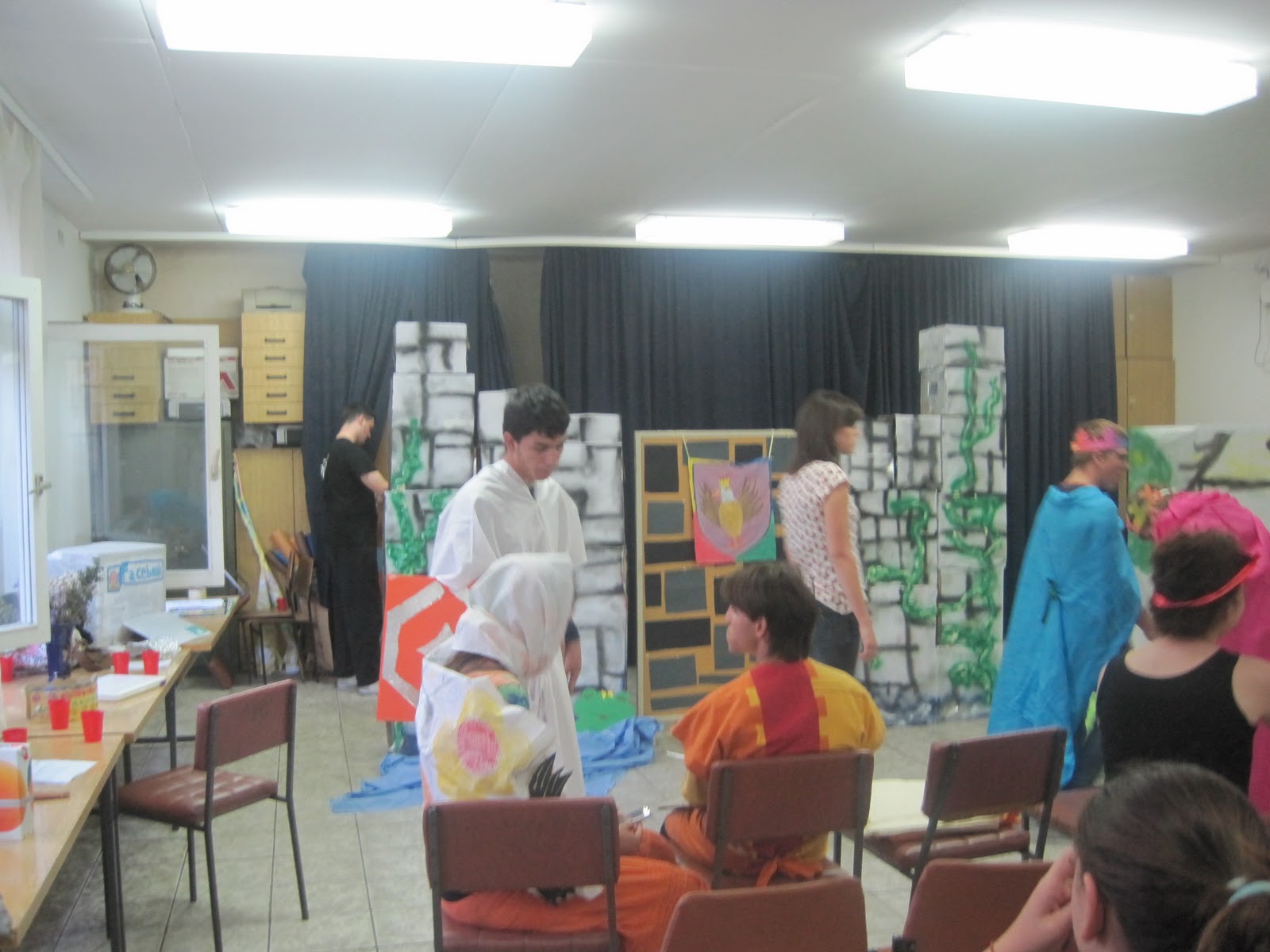
Preparing for a play with the Inclusive Youth Club

Ceca, our fearless leader

The six of us at our weekly meeting

Wednesday, October 5, 2011

Waiting for the Sixth

Today marks eleven years since the one-day revolution that ousted President Slobodan Milošević from power.

There aren't any festivities, no celebrations, not even any commentary from major politicians. Aside from a few news stories, it's a typical Wednesday.

It's not that people here don't consider the 5th of October Revolution a good thing-- most agreed with it at the time, and most still do now. But it didn't go far enough.

The story of the October 5th Revolution is quite inspiring. Отпор/Otpor, a resistance movement whose name is literally "resistance," worked a grassroots campaign to ensure fair elections and to show that the Milošević regime was vulnerable. The opposition parties put aside their differences, and the Democratic Opposition of Serbia fielded a single compromise candidate, Vojislav Koštunica. When Milošević attempted to steal the election, Otpor and the DOS called him out on it. Two weeks later, one million people from all over the country showed up on the streets of Belgrade. The police, after some scuffles, and the army supported the protesters, and the courts declared Koštunica President.

This is the part of the story that's supposed to go, "and they all lived happily ever after." But they didn't. The fall of Milošević didn't bring the fall of corruption and bureaucratic hindrances, or restore pride in the idea of Serbia, or guarantee all Serbians a living wage. It didn't even keep Yugoslavia from disintegrating further: in 2006, Montenegro became independent; in 2008, Kosovo declared independence (current status subject to debate).

The phrase I've most often heard when I ask about the legacy of the revolution is, "We're still waiting for October 6th." The revolution happened, but for the average Serbian, not too much is different. The sweeping changes promised by the DOS were never implemented.

In many countries, major democratic revolutions are turned into national holidays. Here, there's simply no reason to celebrate October 5th.

(B92 English story on the anniversary)
(Radio 021 [Serbian] story)

Edit: President Boris Tadić spoke on the anniversary. He disagrees with the Serbians I talked to, and instead claims that Serbia has moved forward "драматично" (dramatically). Even he concedes that he's disappointed by the lack of progress in some areas, especially the country's "system of values," but notes that it's only been just over a decade.
(B92 English)
(Radio 021 [Serbian])

Tuesday, October 4, 2011

Pride and Prejudices

The second ever Serbian Gay Pride Parade was scheduled for Sunday, October 2 in Belgrade, but it was cancelled by the government at nearly the last minute.

Back at home, the Pride parade is no big deal. We have a few counter-protesters, but they were always peaceful, quiet, and holding up signs misinterpreting select passages of the Bible. My mayor, my friends, and I marched last year.

But there's nowhere like Chapel Hill here in Serbia. Most of the Serbians I've met here were ambivalent about gay rights, or even supportive, but I have to remember that I have the mother of all sampling biases: I'm talking to English-speaking people who have the patience to deal with an American, many of whom are affiliated with NGOs working for other minority rights. The graffiti, as always, shows a rougher side: I remember that during our first week here, I passed some graffiti that read "Ово није земља педера": "This is not a country of faggots."

Last year in Belgrade, six thousand hooligans and right-wing counter-protesters attacked the parade and their riot police protection. They trashed much of the city, and over one hundred cops were injured. This year was expected to be just as bad, and the police were extremely hesitant to provide protection again.

Officially, all major public events in Belgrade this weekend were banned, both the Pride Parade and its several peaceful counter-marches, for Family Values and similar ideologies. In reality, the government caved in to the threat of anti-gay violence.


I haven't faced much prejudice against myself personally as an American. I look plausibly Serbian (enough to fool a few Serbians here) until I attempt to speak the language, but even then, the default assumption is that I'm British. People here seem surprised that an American would visit Serbia, let alone Novi Sad. The most negative reaction I've gotten was from a bus driver, who said to a group of us that he likes us but doesn't like our government. I can respect that. If I mention that I'm from Северна Каролина (North Carolina), they generally respond by either hiding their nonrecognition or by eagerly replying, "Ah, Michael Jordan!"

No one has even attempted to associate me with the NATO bombings during the Bosnian and Kosovo wars. Everybody I've run into has, like the bus driver, clearly been able to separate American bombers from American individuals. I've run into several Bosnian Serbs who were eager to set the record straight for me about the war. One, who identified himself as a refugee, told me that his father, uncles, and grandfathers all served under General Mladić, who is now spending some quality time in The Hague. Mladić was a hero, said the refugee, who is now in his early 20s and studies computer science at a local university. "Do I look like a war criminal?" his friend asked. Standing together outside a hole-in-the-wall fast food place, we all looked like we could have been Princeton students. 

Monday, September 26, 2011

Mađara & more

This weekend, I went on two excursions from Novi Sad. The first was on Saturday morning. I woke up at 5:30 so that I could get ready to catch a bus to Bačko Petrovo Selo, a small village with a population of roughly 7,000, of which 70% are ethnic Hungarians. Igor, the other volunteer, and I were there to document and help Attila, a resident, and his crew of volunteers rebuild old benches in the local park, and pick up trash along the riverside. As far as I could tell, Attila was the only one who spoke any English. Many of the volunteers spoke roughly as much Serbian as I do, and since Hungarian and Serbian are entirely unrelated languages, I didn't understand a word they said in their native tongue. I wasn't alone: Igor spoke no Hungarian either. I felt like an outsider more at that moment than at any other time in my trip.

Volunteers assembling a bench
BPS has only about one or two blocks of "downtown"-- the rest is houses and fields and farms. Igor and I went for a quick walk down to the riverside, where we watched farmers ferrying their tractors and other equipment across: BPS is too small to justify a bridge. Still, they had a football (soccer) field, and what seemed like an active kids' league. Igor explained to me that most small villages have their own football teams, and they often travel locally to play each other.

Ferrying farm equipment
The second excursion was with the other BYP kids. We piled into a van to Subotica, the second largest city in Vojvodina, after Novi Sad. There, we met up (in front of the McDonald's; we joked that it was the only place the Americans would be able to find) with two of Ceca's former students and a local tour guide, who was leading a group of Serbian bankers around the old town hall. All of the signs in Subotica are written in three languages: Serbian cyrillic, Hungarian, and Croatian. The city is only about 10km (6 miles) away from the border with Hungary, and Subotica prides itself on being multiethnic: Hungarians are the plurality, followed by Serbs and Croats and Bunjevci, a small Slavic Catholic ethnic group that is distinct from Croats (not quite sure how).

Old town hall
One of the other BYP-ers asked what the oldest building in Subotica was, and our companions showed us the Franciscan Monastery, which they said was built in the early 1700s. They told us that Subotica didn't have any really old buildings, which amused me and reminded me of a saying I'd heard: in America, 100 years is a long time; in Europe, 100 miles is a long distance.

Synagogue and Holocaust memorial
We also visited the synagogue, which was pretty run down, but still impressive and beautiful, especially the roof. We weren't allowed inside because of fears that the ceiling would collapse. Subotica had one of the largest Jewish populations in Serbia: roughly 7,000. But only around 1,000 survived the fascist occupation, and now the Jewish community numbers around 200. The synagogue is under renovation, but the population simply isn't enough to keep it open. One option is to do as the synagogue in Novi Sad has done: it's now a community center, where you can go to hear classical and choral music. Indeed, the synagogue at Subotica, when reopened, will double as a Jewish culture center.

Chinese food in Serbia: not that different from Chinese food in the US
After lunch (pretty good Chinese food, though to be honest, I prefer Serbian cuisine. Subotica is known for its delicious gulaš, and I'm a little disappointed that we didn't get to try that) we went to the nearby zoo. For the most part, this was really fun. I especially liked the Meerkat exhibit, and I saw the ugliest camel in the world. There were a few sections that were very depressing. The bear and the leopard were kept in cages about as large as my room, and they both looked sad. I know that this sort of mistreatment is by no means unique to Serbia, or even this part of the world; still, the animal rights activist inside of me hurt a little.

A bear, chillin'


Meerkats. Visitors can go into the glass outpost for a closer look.
We played cards on the lakeside for a while, and then drove back to Novi Sad. One thing that I'm still not used to is just how flat Vojvodina is. You see nothing but grain fields for miles in any direction, spotted with both modern farm equipment and horse-drawn plows. Occasionally there's a tower off in the distance, usually the top of some old chapel.

Monday, September 19, 2011

Omladinski Rad i Rođendani

When I've told people about my volunteer service placement at CZOR, I hadn't been able to give any good details on what I'd be doing on a day-to-day basis. A week into work, this is still true.

On Thursday, I helped scan old documents for a cross-boarder project between Hrvatska i Srbija (Croatia and Serbia). Kids from Vukovar, Croatia, and small towns across the Danube in Serbia gave the project pictures from anywhere from the late 1800s to the late 1990s, and even old documents, including property records and military records. One of the people at CZOR was explaining some of the old Serbian documents to me: one was a record of a discharge from a Yugoslav-run internment camp for Germans at the end of the second World War; one was a list of property seized from ethnic Germans as they fled at the end of the war, and who the property was to be given to (ethnic Serbs, of course). These documents, plus pictures and more, will be going on tour around the former Yugoslavia. I think the point of the traveling exhibit is to demonstrate the common history of Croatia and Serbia, and to show that like any groups of people, they have more commonalities than differences.

On Friday, I marched in a protest against corruption. Not too many people showed up for the march, but since we were walking through the Centar, plenty of people saw us. Milan, another volunteer, did a fantastic job of making sure that all of the local media was covering the event. One radio reporter wanted to get quick statements from all of us, but when she came around to me, all I could say was "Ja govorim malo srpski, izvini." We talked briefly in English, but I think she was too confused as to why I was in Serbia and marching in a protest (still a good question) to use my brief footage. Along the way, we mostly got stares, but we also got a few thumbs up, smiles, and witty comments. "Are you protesting for corruption or against corruption?" joked one man, in Serbian. Another asked if any of the political parties were working with our march-- no, they weren't. Obviously, a single march won't do much to fix the corruption endemic to the Serbian political system, but hopefully it will show corrupt politicians that the people actually care, and show cynical Serbians that there's still time to fix the system.

Also on Friday, I was put to work updating the CZOR website with information about the new Master's degree in youth work and community work at the University of Novi Sad. CZOR was instrumental in setting up the bachelor's level degree, but they want to go even further and push for youth work as a real profession.

Today, Sunday, I went with a group of CZOR volunteers to a home for young people with developmental/behavioral/mental disabilities. We took a bunch of the residents to a local park and played games with them, from a dodgeball variation to word association to a game where you had to guess the animal written on your forehead (I was a tiger). We ended with a mini game of fudbol and giving out paper and cardboard "medals" to all of the participants. I'll gladly admit it: I didn't expect anything like this when I landed in the Belgrade airport. I had a lot of fun, and I can tell that our guests did too. Apparently one of the girls living there has taken it upon herself to learn English and is pretty good by now, so I hope to chat with her and help her improve it further.

There's really no quick way to explain what CZOR does. All of these programs are so different, and they're all related to CZOR's core mission of improving the status of young people within the community.

Also this weekend was my host brothers' birthday party. They were both born in August, but since everyone leaves town during August, the family decided to hold off on the party until this Saturday. The party was held in a "rođendaonica" which translates most literally to "birthday place." There are many of these around town. They each have some sort of play structure, blacklight dance room, and gaming consoles. You bring your own food and drinks and rent out the space, and the girls who work there lead the kids in various activities. Ivan overestimated the amount of drinks we'd need, so we have enough juice now to last us for a month or so (not that I'm complaining at all!).

On the first ride home, Nikola grabbed my arm and looked intensely at my watch, playing with its little light. Through his parents, he told me that he had a watch but it had just broken. Remembering this, I had resolved to get each Nikola and Dušan a watch for their birthdays. This was a little more difficult than I expected. Nikola had received his last watch as a gift, so Ivan and Sandra didn't know exactly where it came from. Ivan suggested Futoška Pijaca, which I had heard Ceca mention, and so on his advice, I wandered in.

The market has dozens of stalls selling everything from fresh fruit and vegetables to various shampoos and small appliances to virtually every kind and size of casual to semicasual clothes-- and, to my luck, precisely one stall selling watches and cell phone accessories. Between my broken Serbian and the vendor's broken English, I was able to get most of my point across: I needed two watches for small boys. I saw one model that was absolutely perfect, and I tried to ask for two of it. But when the vendor got his English-speaking friend to come and translate, I was in for a disappointment. He had only the single watch of that model, and all of the other models were either too girly or not digital. I wasn't sure whether haggling was expected in the market, but the price he offered was good enough that I didn't worry about it. I bought the single watch and continued on my search for a second. I finally found a kids store downtown that had superhero digital watches.

On Saturday morning, before their party, I gave my little host brothers their presents: Nikola got the marketplace watch, which had an alarm and timer and a light-up feature, just like he wanted; Dušan got a Spiderman watch. They both thanked me in Serbian and English, and they've been wearing their watches around since then.

While my host brothers' birthday party was this weekend, my friend and Bridge Year comrade Dominique had her real birthday this Friday. Ceca baked her an extremely impressive pair of cakes: the first was a felled log and the second was a stump. They tasted fantastic, except for the core of banana (disclaimer: I can't stand anything banana-related). On Saturday, after my brothers' party, I joined the rest of the BYP crew for a small get-together at Dominique's host family's riverside summer house, where we ate delicious BBQ (Serbian style, not NC pulled-pork BBQ) and the single most delicious food I've had here: a raspberry cake. I swear, I've never had raspberries that came close to being as delicious as those in this cake. Serbia produces about one third of the world's raspberries, and Novi Sad is pretty much in the center of the most fertile area of Serbia, so I'm fairly sure that these raspberries were local. Either way, they were fantastic.

As the cake was being served, I tried to catch on to a Serbian card game. It didn't use a standard Western European deck of cards, but a Hungarian deck. Most Hungarian decks start at VI and go to X, then Under, Over, King, and Ace; the suits are Hearts, Bells, Leaves, and Acorns. For this game, which was mostly like Spades or Hearts, we didn't use the VIs. There are eight sets of rules, and you go in order. One round, you're trying to win the most cards; another, the fewest; another, not hearts; another, not a certain card (I can't even remember which one); and so on. I finally started catching on by the second or third time we went through each ruleset, but I still relied on help from Dominique's host dad and host mom to keep me from being totally destroyed in this game which I still don't know the name of.

I'm not sure what exactly my plans are for the next week and/or weekend, either at CZOR or socially outside of it. My guess is fewer birthdays, and more youth work.

On an entirely unrelated note, I've heard a couple of Serbian phrases that I find interesting.

"Pričaj Srpski da te ceo svet razume," or "Speak Serbian and the whole world will understand," amuses not only me but every Serbian who tells it to me, simply because of its blatant falsehood. Before I left, I was reassured that virtually everyone under the age of 40 would speak some degree of English, and this has been pretty much true so far. I have no doubt that I could get by here without ever trying to learn Serbian, which makes me kind of sad. I want to learn the language!

I see the second phrase mostly in a highly abbreviated form in the license plates and in nationalist graffiti. "Само слога Србина спасава" / "Samo sloga Srbina spasava" or "Only unity saves the Serbs" is turned into a set of four "C"s, two forward, two backward, separated by a cross. Originally coined by the Serbian Orthodox Church, the phrase and symbol represent Serbia on its coat of arms and flag, but when used commonly, they also carry strong nationalist connotations. What amazes me most is that this symbol can be traced back to the Byzantine era.

Tuesday, September 13, 2011

Some thoughts, and a day in the life

I meant to type this up from my notebook last night, but between conversation hour at the American Corner and the beginning of Djokovic's victory, I didn't have any time. All of the "today"s mentioned actually refer to yesterday, September 12, 2011.


Life here is remarkably similar to life in the United States, except with more fresh fruit, less air conditioning, and, of course, conducted in Serbian.

I really feel like the language is the only thing keeping me from understanding this society, but I know that's not true. Langauge is key, but there are all sorts of cultural contexts and memories that I don't even know exist that keep me from fully knowing Novi Sad.

So many people speak English that my minimal Serbian skills are enough to get me by. Both of my homestay parents and everybody at CZOR speaks english fluently. This is incredibly helpful right now, but I'm afraid it will hurt me in the long run. What I'm living in is by no means immersion. Because I don't need to speak Serbian to everyone, I'm simply not getting the practice to become fluent.

To help practice my Serbian, I try to sound out in my head all of the signs I pass by. Sometimes it's easy to guess the meaning, especially from context. This expands my vocabulary, though not always in the most useful way.

For example, I passed a McDonalds ad featuring a potato in a graduation cap. Above it was printed "Prosek 10,0". Prosek, I guessed, meant average: with a 10.0 average, this potato was surely at the top of his class, and, I assume, graduated summa cum trans fat as a packet of fries.

I also try to read the graffiti I pass. I don't understand most of it: it's either nonsense or I lack the context to understand what its meaning is. My favorite is a street that has anti-NATO graffiti on one block, and then two blocks down has LED ZEPPELIN and HÜSKER DÜ painted on the wall. I feel like Serbia is a little wary of western culture, but generally embracing it.

Today was my first "normal" day here. I caught the 8:00 bus to the University for my morning Serbian class. Today we had two new classmates, one from Austria, the other from France. Both have done some self-study and are already better than the class, let alone me.

(Side note: When I think about how I have to wake up at 7:00, it makes me smile some. After all, I was staying up until 7:00 Serbian time /1:00 Eastern time nearly every night last year!)

After class, I went to the office of CZOR, the NGO I'll be working with. There's no way to susinctly describe what exactly I'll be doing while here. This Friday, for example, I'll be in a march against corruption. Some marchers will be dressed as doctors and will hand out samples of "anticorruptin" containing anti-corruption leaflets.

I walked to the city center after I was done, and grabbed some water and people-watched. It was a nice break, and it felt kind of strange to have literally nothing to do. Around 6:00 I walked to the American Corner, which is a sort of cultural embassy found in around a dozen Serbian towns. On Mondays and Wednesdays they have discussion sessions for Serbians to practice their English. Today a representative from the US Embassy in Belgrade dropped by to lead the discussion on the world post-9/11 (I had somehow managed to almost entirely avoid news coverage of the anniversary). The conversation was fine, though the diplomat managed to talk more than nearly all of the Serbians. Afterwards, he and I talked briefly about the foreign service, and he encouraged me to apply. I'll seriously consider it.

Going home, I nearly got on the wrong bus! Well, that's not quite true. It was the right bus in the wrong direction. Fortunately, I double-checked at the last second. I caught a #6 bus going through Telep and found my stop without too much trouble.

Saturday, September 10, 2011

Političar i Porodica

I have so much to say that I don't even know where to begin.

Around 8:00 we were picked up in two black Škodas with tinted windows and taken into a gated community to have breakfast at the house of a local member of the Serbian Parliament. Nenad Čanak, leader of the League of Social Democrats of Vojvodina, had originally invited us for some sort of lunch discussion, but various reschedulings pushed us to this morning.

I have to admit, sitting behind the tinted windows and listening to the europop/electronica as the driver wove through slower traffic made me feel like I was in some sort of B-roll gangster/heist movie.

Čanak invited one of his fellow MPs (Aleksandra, whose last name I've already forgotten) to eat breakfast with us. The meal was huge, and none of us (not even your dearest Pera Ždera) were able to finish all we had been offered. But despite the pork, game, sausages, ham, and other delicious food on the table, the real meat of the morning was in the conversation.

Čanak started by asking if anyone had any questions, which I stupidly thought was an honest plea for questions. Instead he quickly dived into a quick lecture on Balkan history and Serbian politics starting around the late nineteenth century. He talked about how every tiny nation emerging in between Austro-Hungary and the receding Ottoman Empire had a concept of "Greater ____." The idea was familiar to me from not only my reading about Serbia but also my research about Greece before MiniTerm this year. Every very-minor power had conflicting territorial claims that were far, far greater than they could ever dream of holding. But it was these claims that gave the new nations hope.

One part causing this and one part caused by this, the Balkans, especially around Serbia, is pretty ethnically mixed. So mixed that there's no way that any contiguous national borders can ever include all Serbs or exclude all non-Serbs. This wasn't too big of a problem under the Kingdom of Slovenes, Croats, and Serbs, which became the Kingdom of Yugoslavia, and later Tito's communist Yugoslavia, since statesmen just shoved them all into the same nation and called the problem solved. But when "Brotherhood and Unity" fell apart, Serbs, Croats, Bosniaks, and Albanians couldn't divorce peacefully like the Czechs and Slovaks did.

Čanak protested the war, and led hundreds with him in his cause. He was jailed and drafted as a result. He was sent to Vukovar, Croatia, which the Serb-run Yugoslav National Army sieged for nearly three months. The war wouldn't break him, and he returned to protest the Kosovo War and to help in the October 5th Revolution (Čanak called it a coup) that brought down Slobodan Milošević.

Like Nikola, Čanak would consider himself a realist, but unlike Nikola, the only future he sees for Serbia is continued European integration (If the EU still exists, he qualified). The only way to settle border disputes and "Greater ____" ambitions is to make borders irrelevant. Who will argue over the precise border between Serbia and Kosovo when they both follow the exact same laws and customs?

Also like Nikola, Čanak seemed jaded about the prospect of today's Serbian youth. They care more about partying and living for the present, they only join political parties so they can work their way up and earn a job, they see politics as a means for themselves rather than something greater. I hope, for Serbia's sake, that he's wrong on this one.

For the record, there's so much more that Čanak said, and so much complexity to everything I've already mentioned, that there's no way I can do it real justice. There's no substitute for the man himself in full swing.

(Remind me to post pictures from the breakfast sometime tomorrow. It's late and I'm too lazy to find my USB cord.)


Around 4:00 this afternoon, we all walked to a small café/restaurant and prepared a few short sentences in our simple Serbian to introduce ourselves to all of the host families. Mine was:
Ćao! Zovem se Tucker. Moj srpski nadimak je Pera Ždera. Ja sam iz Severne Karoline. Imam osmanaest godina. Ja sam jedinac, i volim da čitam.
or, in English,
Ciao! My name is Tucker. My Serbian nickname is Peter the Eater. I'm from North Carolina. I'm eighteen years old. I'm an only child, and I like to read.
These few phrases were taxing my Serbian ability, but the audience was appreciative anyway.

I met my family, the Lukićs. Ivan and Sandra (another Aleksandra, I know, I know...) are my host parents, and Nikola and Dušan, eight and five years old, respectively, are my little host brothers. Nikola knows English far better than I know Serbian, which embarrasses me a little. Ivan's fluent in English and Sandra's pretty close. Both of the little boys were shy at first (as was I) but we bonded over flicking a bottle cap across the café table.

On the car ride over, the boys asked me many questions, only one or two of which I could comprehend and answer, and most of which went without Ivan or Sandra's translation, since they were trying to drive and to hold a more intellectual conversation with me. Dušan began calling me "Duck," which I guess I won't stop him from doing. After registering my change of residence with the local police office, the Lukićs took me to their wonderful home in Telep, a neighborhood of Novi Sad that I hadn't visited yet. There I met Meda, their giant labrador retriever, the only member of the family who understands less Serbian than I do (I was pretty quick to learn "sit").

Ivan, with a straight face, sat down with me outside and told me that he would always address me by Mr. Jones, that I would always refer to him as Mr. Lukić, and that I wasn't to refer to or look at his wife at all. The boys, he said, should always be called "the offspring," though I could number them if I needed to differentiate. Fortunately, a previous Bridge Year student had warned me about Ivan's very dry sense of humor, so I smiled and played along. He later called the offspring over and told them that they were to call me Mr. Jones, so now when they want my attention they have a choice between "Duck" and "Meesterdjons!" After dinner, Ivan put on Mr. Jones by Counting Crows (which, incidentally, is as old as I am) and Nikola danced along.

During our car ride, Nikola noticed my very simple string-and-bead bracelet that we made at Bridge Year orientation, and after dinner he gave me a bracelet that he had woven out of string earlier. He then came up with a big pair of scissors saying something in Serbian, so I decided that I'd trim the bracelet with his help, instead of vice versa as he had been planning. Dušan then called me over to the computer to play Angry Birds: Rio with him.

Ivan and I discussed a variety of topics, from politics to books to computers, until we both got pretty tired. I was about ready to go upstairs to bed, when I realized I had forgotten about my host family gifts! I dove into my suitcase and pulled the protective packing (spare socks) off of two bottles of Cackalacky sauce, which Ivan and Sandra seemed to appreciate. They say they'll try it out tomorrow, so here's to North Cackalack.

My bedroom is great- I'm upstairs with shelves of books, magazines, and VHS tapes, and sharing the floor with me is nothing but the billiards room and the balcony.

Tomorrow, I'll get pictures of the family, the home, and the dog. For now, bed!